Central Limit Theorem (CLT)
Maths: Statistics for machine learning
2 min read
This section is 2 min read, full guide is 105 min read
Published Oct 22 2025, updated Aug 17 2026
40
Show sections list
0
Log in to enable the "Like" button
0
Guide comments
0
Log in to enable the "Save" button
Respond to this guide
Guide Sections
Guide Comments
Machine LearningMathsNumPyPandasPythonStatistics
The Central Limit Theorem (CLT) is one of the most important concepts in statistics.
It states that the sampling distribution of the sample mean will approach a normal (bell-shaped) distribution, regardless of the shape of the original population, as long as the sample size is sufficiently large (typically n ≥ 30).
In simple terms:
“No matter what your data looks like, if you take enough random samples and average them, the distribution of those averages will look normal.”
Key Points
- Works for any population distribution — whether it’s skewed, uniform, or irregular.
- As sample size (n) increases:
- The sampling distribution of the mean becomes more symmetric and normal.
- The standard error (spread of sample means) gets smaller.
- The mean of the sampling distribution equals the population mean (μ).
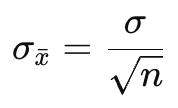
- The standard deviation of the sampling distribution (the standard error) is:
Why It Matters
- Enables use of Normal Distribution methods (Z-scores, confidence intervals, hypothesis tests) even when population data are not normal.
- Forms the foundation for statistical inference and many machine learning techniques that assume normally distributed errors or averages.
Example
Even if your population is heavily skewed (like income data), if you repeatedly:
- Take random samples of size n ≥ 30
- Calculate their means
- Plot those means
…the result will approximate a Normal Distribution centred around the true population mean.