Chi-Squared Test
Maths: Statistics for machine learning
3 min read
Published Oct 22 2025, updated Aug 17 2026
Guide Sections
Guide Comments
The Chi-Squared test (pronounced “kai-squared”) is a statistical hypothesis test used to determine whether there is a significant relationship between categorical variables or whether observed frequencies differ from expected frequencies.
It’s one of the most widely used non-parametric tests for discrete (count) data.
In simple terms:
“The Chi-Squared test checks whether what you observed is different from what you expected — for example, are two categorical variables related, or are differences just due to chance?”
When to Use It
- Data are categorical - e.g., gender, colour, product type, etc
- You have counts/frequencies - Observed vs expected
- Expected frequency per cell ≥ 5 - (for accuracy)
When Not to Use It
- Data are continuous - Use other tests (t, ANOVA, etc.)
- Small sample (< 5 per cell) - Use Fisher’s exact test
Types of Chi-Squared Tests
- Goodness-of-Fit Test - Tests whether observed frequencies match expected proportions eg. “Are dice fair?”
- Test of Independence - Tests whether two categorical variables are related eg. "Is gender related to buying preference?”
- Test of Homogeneity - Tests whether distributions are the same across populations eg. “Do different stores sell similar proportions of products?”
1. Goodness-of-Fit Test
Hypotheses
- H₀ (Null) - Observed frequencies match expected frequencies
- H₁ (Alt) - Observed frequencies differ from expected frequencies
Formula:

Where:
- Oi = observed frequency
- Ei = expected frequency
Degrees of Freedom (df): df = k − 1
where k = number of categories
Example: Are dice fair?
You roll a die 60 times and get:
Face | 1 | 2 | 3 | 4 | 5 | 6 |
Observed (O) | 8 | 9 | 10 | 12 | 11 | 10 |
Expected (E) = 10 each (since fair die → equal chance)
Python Example
import numpy as npfrom scipy.stats import chisquareobserved = np.array([8, 9, 10, 12, 11, 10])expected = np.array([10, 10, 10, 10, 10, 10])chi2, p = chisquare(observed, expected)print(f"Chi-Squared Statistic: {chi2:.3f}")print(f"P-value: {p:.4f}")if p > 0.05: print("No significant difference — die appears fair.")else: print("Significant difference — die may be biased.")Interpretation:
- p > 0.05 → data fit the expected distribution (no bias)
- p ≤ 0.05 → observed frequencies differ significantly (possible bias)
2. Chi-Squared Test of Independence
Used with a contingency table — tests if two categorical variables are related or independent.
Hypotheses
- H₀ (Null) - The variables are independent
- H₁ (Alt) - The variables are dependent (associated)
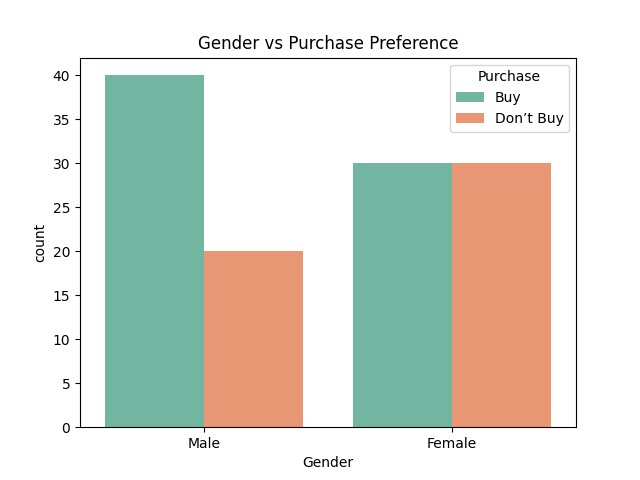
Example: Gender vs Purchase Preference
Preference | Buy | Don’t Buy | Total |
Male | 40 | 20 | 60 |
Female | 30 | 30 | 60 |
Total | 70 | 50 | 120 |
Python Example
import numpy as npimport pandas as pdfrom scipy.stats import chi2_contingency# Contingency tabledata = np.array([[40, 20], [30, 30]])chi2, p, dof, expected = chi2_contingency(data)print(f"Chi-Squared Statistic: {chi2:.3f}")print(f"Degrees of Freedom: {dof}")print(f"P-value: {p:.4f}")print("Expected Frequencies:\n", expected)if p < 0.05: print("Reject H₀ — variables are dependent (related).")else: print("Fail to reject H₀ — variables are independent.")Interpretation:
- If p < 0.05 → significant relationship (e.g., gender affects buying)
- If p > 0.05 → no evidence of relationship (variables independent)
3. Chi-Squared Test of Homogeneity
Similar to the independence test but used to compare distributions across different populations (e.g., region A vs region B sales distribution).
Same formula, same interpretation — only the data come from different samples rather than one sample classified by two variables.
Degrees of Freedom (df):
For independence or homogeneity:

where:
- r = number of rows (categories of variable 1)
- c = number of columns (categories of variable 2)
Visualisation Example
import pandas as pdimport seaborn as snsimport matplotlib.pyplot as pltdf = pd.DataFrame({ 'Gender': ['Male'] * 60 + ['Female'] * 60, 'Purchase': ['Buy'] * 40 + ['Don’t Buy'] * 20 + ['Buy'] * 30 + ['Don’t Buy'] * 30})sns.countplot(data=df, x='Gender', hue='Purchase', palette='Set2')plt.title("Gender vs Purchase Preference")plt.show()The visual helps show whether proportions differ across categories.
Assumptions
- Data type - Frequencies/counts (not percentages)
- Independence - Observations must be independent
- Expected frequencies - ≥ 5 per cell for valid χ² approximation
- Sample size - Reasonably large
Python code
import pingouin as pgimport pandas as pd# Example raw datadf = pd.DataFrame({ 'fbs': [0, 1, 1, 0, 0, 1, 0, 1, 1, 0], # Fasting blood sugar 'target': [1, 1, 0, 0, 1, 0, 1, 1, 0, 0] # Heart disease})# Run chi-squared test on raw categorical columnsexpected, observed, stats = pg.chi2_independence(data=df, x='fbs', y='target')print("Observed Frequencies:\n", observed)print("\nExpected Frequencies:\n", expected)print("\nTest Results:\n", stats)Outputs:
Observed Frequencies: target 0 1fbs 0 2.5 2.51 2.5 2.5Expected Frequencies: target 0 1fbs 0 2.5 2.51 2.5 2.5Test Results: test lambda chi2 dof pval cramer power0 pearson 1.000000 0.0 1.0 1.0 0.0 0.051 cressie-read 0.666667 0.0 1.0 1.0 0.0 0.052 log-likelihood 0.000000 0.0 1.0 1.0 0.0 0.053 freeman-tukey -0.500000 0.0 1.0 1.0 0.0 0.054 mod-log-likelihood -1.000000 0.0 1.0 1.0 0.0 0.055 neyman -2.000000 0.0 1.0 1.0 0.0 0.05