Z-Test and Hypothesis Testing
Maths: Statistics for machine learning
3 min read
Published Oct 22 2025, updated Aug 17 2026
Guide Sections
Guide Comments
A Z-test is a statistical hypothesis test used to determine whether there is a significant difference between a sample mean and a population mean, or between the means of two samples, when the population standard deviation (σ) is known and/or the sample size is large (n ≥ 30).
In simple terms:
“A Z-test checks if a sample mean is far enough away from what we expect — in standard deviation units — to suggest a real difference rather than random variation.”
When to Use a Z-Test
Use a Z-test when:
- The population standard deviation (σ) is known
- The sample size is large (n ≥ 30) (Central Limit Theorem applies)
- The data are approximately normally distributed
If σ is unknown and n is small, use a T-test instead.
Types of Z-Tests
Test Type | Purpose | Example |
One-sample Z-test | Compare a sample mean to a population mean | “Is the average height of students different from 170 cm?” |
Two-sample Z-test | Compare two independent sample means | “Do males and females have different average test scores?” |
Z-test for proportions | Compare sample proportion(s) to a population or another group | “Did more than 60% of users click the ad?” |
Hypothesis Setup
Symbol | Meaning | Example |
H₀ (Null Hypothesis) | No difference or effect | μ = μ₀ (e.g. mean = 50) |
H₁ (Alternative Hypothesis) | There is a difference | μ ≠ μ₀ (two-tailed) or μ > μ₀ / μ < μ₀ (one-tailed) |
You start by assuming H₀ is true, then use your data to test if it should be rejected.
Z-Test Formula
For a one-sample Z-test:

Where:
- X = sample mean
- μ0 = population mean under H₀
- σ = population standard deviation
- n = sample size
Decision Rule
- Choose a significance level (α) (commonly 0.05).
- Find the critical Z-value:
- Two-tailed test: ±1.96 (for α = 0.05)
- One-tailed test: ±1.645 (for α = 0.05)
- Compute your Z-statistic using the formula.
- Compare:
- If |Z| > Z-critical, reject H₀ (significant difference).
- Otherwise, fail to reject H₀.
Example
A sample of 50 students has an average test score of 78.
The population mean is 75, with a known σ = 10.
At α = 0.05, is the difference significant?
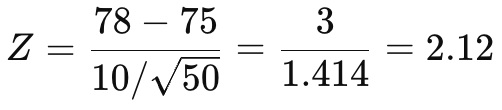
Compare with critical Z (±1.96 for 95% confidence):
|2.12| > 1.96 → Reject H₀
Interpretation:
There is a statistically significant difference between the sample mean and population mean.
P-Value Approach
You can also interpret the Z-test using the p-value:
- Find p-value from Z (e.g., p = 0.034).
- Compare with α = 0.05.
- If p ≤ α → Reject H₀, else Fail to reject H₀.
Same conclusion as using Z-critical values.
Visual Understanding
- The Z-distribution (standard normal) is centred at 0.
- The tails represent rare or extreme outcomes.
- If your Z-statistic lies in the tails (beyond ±Z-critical), your result is unlikely under H₀.
A two-tailed test shades both ends of the normal curve (extreme low and high).
A one-tailed test shades only one end.